
Pre-seed funding for AI startups isn’t about revenue. Run four checks before you pitch an investor, and raise only what your plan needs.
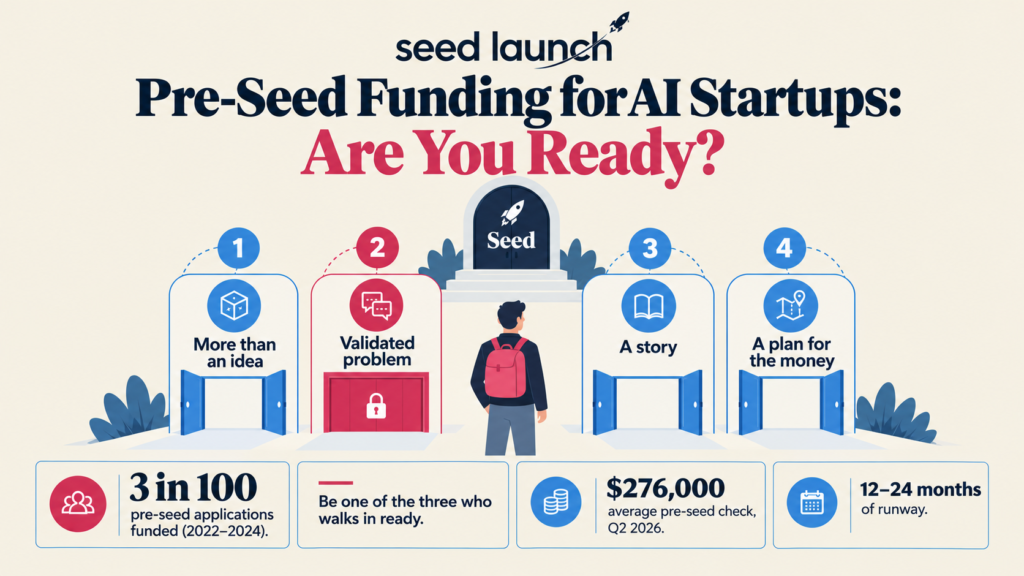
The average pre-seed check hit $276,000 in Q2 2026. That’s a record, up 27% from a year earlier.
Founders read that number and hear good news. I hear a warning. A bigger average check doesn’t make the room easier, and investors still pass on most of the teams who walk in. If you’re planning pre-seed funding for AI startups, run four checks before you send a single email.
What Pre-Seed Funding Actually Pays For
Pre-seed is the earliest money a company takes. It turns a raw idea into a tested concept or a first MVP. Most rounds land between $150,000 and $1 million, and 93% of rounds in Q2 2026 used SAFEs (simple agreements for future equity), per the same data.
Founders spend it on incorporation, customer research, a first MVP, and the first hire or two.
Seed is a different game. Pre-seed is about finding the right questions. Seed is about having some of the answers. Founders who mix the two end up pitching a seed story with pre-seed proof.
Four Checks to Run Before You Email an Investor
Run these in order. You need a yes on every one.
First, do you have more than an idea? Investors want to see progress. A prototype, a detailed mockup, or a no-code MVP all count. For an AI founder, a working demo on real data beats any deck.
Second, have you validated the problem? That means interviews with a specific audience and real evidence that those people want a fix. Conversations count. Compliments from friends don’t.
Third, do you have a story? At this stage, investors back you as much as your product. They want to know why this problem, why now, and why your team.
Fourth, do you have a plan for the money? Skip the complex model. Write a short roadmap: the milestones you’ll hit, the hires you’ll make, and the 12 to 24 months of runway the round buys.
Here’s the thesis. If you can’t say yes to all four, you don’t have a fundraising problem. You have a clarity problem, and more investor meetings won’t fix it.
Positioning and GTM Decide Who Gets Funded
Positioning, GTM and product-market fit are the things that quietly decide who gets funded. Founders treat them as work for after the money lands. Investors read them as proof you understand your buyer. If your homepage sounds like everyone else’s, start with why every AI startup homepage sounds the same. If growth feels stuck, your positioning might be the real problem, and GTM is a strategy question, not a marketing one. To see the investor’s side, read what investors look for before Series A funding.
Why Most AI Founders Stall on Check Two
Building got cheap. With today’s AI tools, you can ship a working demo in days. So can everyone else, which means investors have now seen a hundred demos that look like yours.
Picture a demo that summarizes contracts in seconds. The investor asks one question: who pays for this today, and what do they use now? If the answer is “legal teams, probably,” the demo stops mattering.
What investors haven’t seen is proof that a specific buyer has a painful problem and will pay to solve it. That proof is product-market fit work, and it’s where I watch AI founders skip ahead. They polish the model and put off the buyer conversations. The pitch ends up with a sharp demo and a vague customer.
Fix that first.
Fix that first. Keep talking to buyers until you can describe their pain in their words, not yours. Here’s how to get your first 10 customers in 90 days.
The Odds Are 3 in 100. Plan Like It.
Across 12,000+ funding applications reviewed by angel groups, only 3% of pre-seed applications got funded. Rounds also take months from the first conversation to money in the bank.
You can’t control the market. You can control whether you’re ready when a good investor leans in.
Run the Checks This Week
Pull up the four checks and mark the ones you’d fail today. Be honest. Most founders fail one, and it’s usually the second.
If you can’t pass check two yet, SeedLaunch’s Seed plan helps you find out whether your product fits a market before you pitch, and the Scale plan picks up from there once you have it.