
We read through 37 websites belonging to recently funded AI startups last month, looking for nothing in particular — just curious what the current crop of funded AI companies was actually saying to the world.
By website twelve, we noticed a pattern. By website twenty, we stopped being surprised by it. By website thirty-seven, we were mildly depressed — and it made us realize almost none of them had real AI startup positioning.
Almost every one of them said some version of the same three sentences.
“AI-powered platform that helps businesses automate workflows.”
Or: “AI Copilot for [noun here].”
Or, our personal least favorite: “The future of work, powered by AI.”
We read the first screen of each site — headline, subhead, hero image, maybe a scroll further if we were feeling generous. Afterward, we genuinely could not tell you three things: who the product was for, what painful problem it solved, or why it was different from the eleven other tabs we had open at the same time.
Not because the founders hadn’t thought about it. We’d bet almost all of them could answer those three questions perfectly well on a call, with total conviction, the same way every founder we work with can. The problem wasn’t in their heads. It was on their homepage.
Here’s the part that makes this genuinely funny, in a bleak way: these are, by definition, some of the most technically capable founders operating right now. They raised money. They shipped a working product. Several of them, we’d guess, are using AI to write half their own marketing copy.
And still — somehow — the copy says nothing.
Building Got Easy — AI Startup Positioning Didn’t
According to AWS’s 2026 “Engines of Growth” startup report, AI-native startups are hitting billion-dollar valuations in roughly half the time it took companies in the pre-GenAI era. They’re doing it with meaningfully smaller teams. Read that twice, because it’s not a small claim.
A category-defining company used to take a decade and two hundred employees. Now it can take a few years and a lean team with the right tools.
That’s a genuinely remarkable shift, and it should be exciting. But it also explains exactly why every AI startup homepage sounds the same. When the barrier to building a working product drops that fast, everyone rushes through the door at once, and they all show up wearing the same outfit.
“AI-powered.” “Automate.” “Copilot.” “The future of work.” These aren’t lies. They’re just no longer information. They stopped differentiating anyone the moment they became the default vocabulary of an entire funding cycle.
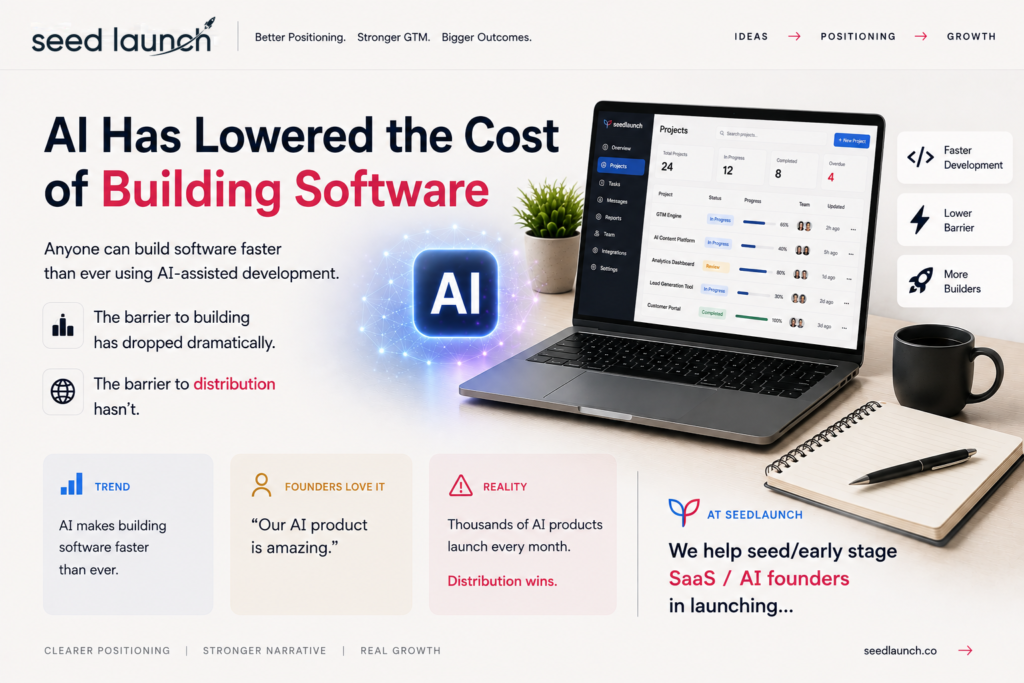
Here’s the uncomfortable logic underneath all of it: when everyone can build the thing quickly, building the thing stops being the advantage. Your model isn’t your moat. Your feature set isn’t your moat either, because it’ll be matched in a quarter, maybe less.
What’s left, once the technical playing field flattens out, is the thing that’s actually hard to copy: whether anyone, anywhere, immediately understands what you do and who you built it for.
Distribution becomes the moat. Positioning becomes the moat. Narrative becomes the moat. And narrative, unlike a feature, cannot be reverse-engineered from a demo.

Why “We’ll Fix the Copy Later” Doesn’t Work
We want to push back on an assumption we hear constantly, usually from founders who are otherwise sharp about everything else in their business: the idea that the words on the homepage are a finishing touch. Something you hire out once the product is “done.” A coat of paint.
That’s backwards, and it’s backwards in a way that costs real money. Copy is not the layer on top of positioning — copy is the evidence of positioning.
If your homepage is vague, it’s not because your writer had an off day. It’s because nobody in the company has actually made the decision, in one written sentence, about who this is for and why it beats the alternative.
A brilliant copywriter handed a fuzzy answer to “who’s this for” will hand you back fuzzy language with excellent grammar. It’ll read smoothly. It will convert almost nobody, because there’s nothing underneath it for a reader to grab onto.
This is precisely why so many of those 37 homepages read like they were assembled from the same template, even though the products behind them are, we assume, genuinely different from one another. The founders skipped the hard, un-fun work of deciding — really deciding, on paper, out loud, uncomfortably — exactly who they’re for and who they are emphatically not for.
Then they asked marketing to paper over that gap with adjectives. Marketing can’t do that. It was never marketing’s job to do that.
What the 37 Got Wrong, and What a Handful Got Right
A small number of the sites we read broke the pattern, and every single one of them did it the same way: specificity where everyone else defaulted to breadth.
Not “AI platform for teams.” Instead, something closer to: this is for the operations lead at a 40-person logistics company who currently loses four hours a week reconciling shipment data across three disconnected tools.
You read that sentence and you either feel a jolt of recognition, or you correctly conclude this isn’t for you and move on. Both outcomes are wins. A prospect who self-selects out in five seconds was never going to buy anyway — you’ve just saved everyone a sales call.
That’s the actual test we’d give any founder staring at their own homepage right now: read your positioning statement out loud to ten strangers who plausibly fit your target market. If at least a couple of them don’t visibly react, the statement is still too soft, no matter how polished the sentences around it sound.
Vague positioning feels safer because it seems to reach more people. It doesn’t. It reaches everyone a little and convinces nobody enough to act. A narrow, true statement will always outperform a broad, hedged one — every time you actually test it against a real reader instead of an internal team that already knows the context.
Why Positioning Is the New Moat
We don’t think the next generation of category leaders in AI is going to be the teams that built the technically superior model. Technical superiority now has a shelf life measured in months, in a world where building fast and lean is the baseline rather than the differentiator.
What doesn’t have that expiration date is a founder who can tell you, in one sentence, exactly who they built this for and exactly what breaks in that person’s week without it.
That’s not a copywriting skill. It’s a strategic decision that only the founder has enough context to make, and then the discipline to say no to everyone who doesn’t fit it. It’s uncomfortable in exactly the way any real commitment is uncomfortable: it means turning away the “maybe” customers to speak clearly to the right ones.
If you’ve read this and recognized your own homepage in the “AI-powered platform” pile, we’d say the same thing to you that we said to Dev a few weeks back: you’re not behind, and your product is very possibly fine.
You’re just standing at the part almost every funded AI founder is standing at right now, whether they’ve admitted it yet or not. The product was never actually the hard part. It’s just the part people notice they got right first — and, almost always, the last part they notice they never finished.
This is the same pattern we later saw play out inside a company that couldn’t even agree internally on who its customer was — the words on the homepage were never really the problem. They were just where the real problem finally became visible.
Your AI isn’t your competitive advantage anymore — everyone in your category has one too. Your clarity is. If your homepage still reads like the other 36, that’s usually a positioning problem, not a product one — and it’s fixable in weeks, not quarters.