
Learn how to know product market fit with four checks based on user behavior, not opinions, so you stop guessing and start building on proof.
Ask ten AI founders if they have product market fit and nine will say “almost.” That word is the answer. You don’t almost have fit.
If you want to know how to know product market fit, the short version is this: watch what users do, not what they say. Opinions are cheap. Behavior is the proof.
Why “Almost” Usually Means No
Founders collect good signs. A user says “this is cool.” An investor takes the call. A demo gets applause. Every one of those feels like progress, and none of them is fit.
AI makes this worse. People are curious about the technology itself, so they try your product and say nice things. Curiosity fades fast. A product that people need doesn’t fade.
So stop asking “do people like it?” Ask “would they be upset if it disappeared?” That question is harder to answer, and it’s the one that matters.
How to Know Product Market Fit: Four Checks
You don’t need a fancy dashboard. You need four honest answer
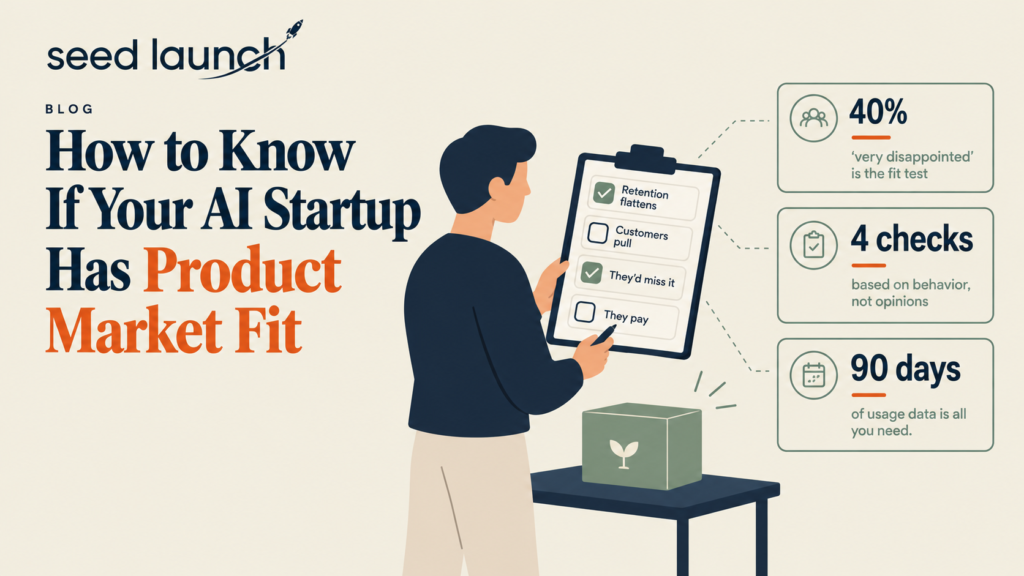
Does retention flatten? Group your users by the month they signed up and track how many are still active. If every group falls to zero, you have a demo. If the line levels off at a number above zero, a real group of people has built your product into their week.
Do customers pull you forward? When fit is real, users ask for features without being prompted. They bring in colleagues. Your sales cycle gets shorter. You spend less time pushing and more time answering.
Would they miss it? Ask people who have used the product at least twice how they would feel if they could no longer use it. If 40% or more say “very disappointed,” you’re on to something. That’s the Sean Ellis test, and it’s still the simplest fit check around. If most say “somewhat disappointed,” you’re not there.
Do they pay without a fight? Real fit shows up in money. Customers pay close to list price, renew, and expand. If every deal needs a big discount, the market is telling you something.
One bonus check. Can you describe your buyer in one sentence? If it takes three, your positioning is still blurry, and fit will stay out of reach.
Run These Checks This Month
This takes a week, not a quarter. Pull the last 90 days of usage data and build the retention view. Send the “how would you feel” question to every active user. Count the customers who came in without you personally selling to them. Write all four results on one page.
If two or more checks fail, you’re pre-fit. That’s fine. It tells you exactly where to work, which is more than most founders know.
Why Guessing Is Expensive Right Now
Anyone can ship an AI demo in a weekend, so buyers are skeptical and investors ask harder questions. Capital is tighter than it was. You can’t afford to hire a sales team or buy ads for a product that people try once and drop.
Here’s the number to keep in mind: 73% of seed startups never reach Series A. In our experience the cause is rarely the product. It’s GTM confusion, and it often starts with a founder who believed they had fit before they did.
Know Where You Stand
You don’t need a perfect score. You need an honest one. Run the four checks, write down what you find, and decide what to fix first.
If you’ve done that and the answers still feel muddy, contact us at SeedLaunch. We’ll go through your numbers with you.