
Wondering how to get your first 10 customers? Skip the traffic push. Here’s the hand-built 90-day process AI founders can repeat.
Ninety Days, Zero Customers
Ninety days after launch, a founder I worked with had a working product, a decent-looking website, and exactly zero paying customers. Not because nobody needed the product — three prospects had said yes in discovery calls. Nobody had converted, because “converting” wasn’t a process. It was a hope that people who liked the demo would eventually just sign up.
That gap between interest and customers is where most AI founders quietly stall. It’s not a marketing problem. It’s a systems problem.
Your First 10 Customers Are a Process Goal, Not a Traffic Goal
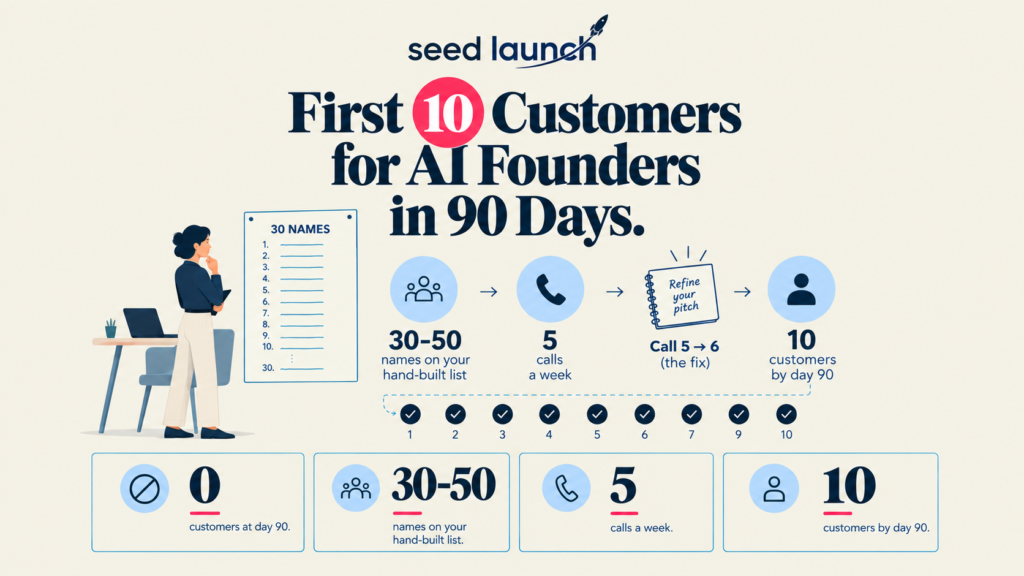
Founders default to more visibility when growth stalls — more posts, more ads, another launch push. But getting to 10 customers in 90 days for AI founders almost never comes from more volume. It comes from a repeatable path: a specific list of people who match your ICP, a specific reason each one should care right now, and a specific next step you ask for every single time. Miss any of the three and even good interest evaporates into “let me think about it.”
The founders who get there fast don’t run more experiments. They run the same conversation with the same offer, over and over. The sample is small enough that they can fix what breaks between call five and call six. Paul Graham made the same point in his essay Do Things That Don’t Scale: the most common unscalable task for a founder is recruiting users by hand.
If volume really is your bottleneck, that’s a different problem. Our page on growing demand generation covers it.
The 0-to-10 Motion, Not the 0-to-1,000 Motion
Treat your first 10 customers as a hand-built process, not a scaled one. Build a list of 30 to 50 people who look exactly like your best-fit buyer. Reach out personally, not through a form. Get on a call, and ask directly for the sale or the next concrete step, not “let me know what you think.” After every call, write down what almost stopped the deal. By customer six or seven, you’ll have a pattern you can repeat on purpose instead of a demo you’re hoping lands.
This is slow, unglamorous work. It’s also the only version of “traction” that means anything to the next investor you talk to.
What to Write Down After Every Call
After every call, write down what almost stopped the deal. Was it price? A missing integration? A security question you answered badly? Five columns in a spreadsheet are enough: who they were, what they said they’d do, what you asked for, what they did next, and what almost killed it.
Around customer six or seven, a pattern shows up. Two or three objections cause most of your lost deals. Fix those, and your close rate moves more than any ad budget would. You now have a process you can repeat on purpose, instead of a demo you’re hoping lands.
Buyers Have Seen the Demo Before
AI tools have made it cheap to build something that looks impressive in a demo. That’s exactly why buyers are more skeptical, not less. They’ve seen the demo before. Some of them have been burned by products that fell apart after week one. The AI founders who land their first 10 customers fastest aren’t the ones with the flashiest product. They treat each early customer as a relationship to earn, not a number to log.
If you’re past launch and still stuck at zero, you don’t need more reach. You need a list of 30 names and one clear ask. If you want help building that list, book a call about the Scale partnership.
# first 10 customers