
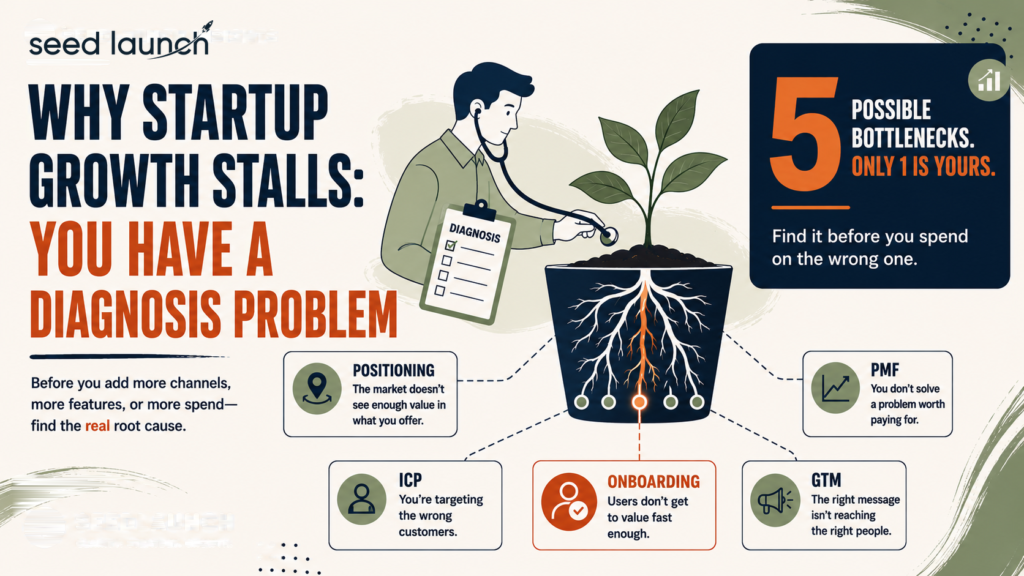
Most stalled startups don’t need more leads or ad spend — they need to find the actual bottleneck first. Here’s how to diagnose it.
You Have a Diagnosis Problem, Not a Growth Problem
A founder I worked with last year had just closed her seed round and spent four months doing everything the playbooks told her to do. She hired a growth marketer. She doubled her ad budget. She added three features her sales team said prospects kept asking for. Revenue moved from flat to slightly-less-flat, and she was burning through runway trying to figure out which lever was broken.
None of them were broken, exactly. She just didn’t know which one mattered.
That’s the pattern I see over and over with seed-stage SaaS and AI founders. Growth stalls, and the instinct is always the same: more leads, more ad spend, better salespeople, more features. Those are guesses dressed up as strategy. They feel like action, which is why founders reach for them first. But guessing at the fix before you know the diagnosis is how you burn six months and a chunk of your raise finding out the real problem was never lead volume at all.
The Bottleneck Is Rarely Where You’re Looking
Here’s the thing about stalled growth: the symptom and the cause are almost never in the same place. Founders feel the pain in their pipeline — not enough demos, deals stalling, CAC creeping up — and assume the fix belongs in that same part of the funnel. So they throw sales and marketing spend at a problem that’s actually upstream.
In my experience, the real bottleneck is usually one of five things: weak positioning, a product that hasn’t found fit yet, an ICP that’s too broad or just wrong, onboarding that loses people before they see value, or a GTM strategy that was never actually built — just assembled from tactics that sounded reasonable at the time. Every dollar you spend on lead gen before you’ve ruled these out is an experiment, not a strategy. Sometimes the experiment works. Most of the time it just teaches you, expensively, that the problem was somewhere else.
Treat Your Startup Like a Patient, Not a Project
Nobody takes medicine before getting a diagnosis. You don’t treat a headache with chemotherapy because chemotherapy is powerful. But founders do the equivalent of this constantly — reaching for the most aggressive tool available (more ad spend, a bigger sales team) before they’ve confirmed that’s actually where the sickness lives.
The founders who grow fastest aren’t the ones who move fastest. They’re the ones who diagnose accurately before they move at all. That’s a harder discipline than it sounds, because diagnosing feels slower than doing, and slow feels dangerous when your runway clock is running. But an accurate diagnosis that takes a week beats three months of confident action in the wrong direction, every time.
Why This Matters More Right Now
Capital is tighter than it was two years ago, and buyers are more skeptical of anything that smells like generic AI-startup noise. That combination punishes guessing harder than it used to. You don’t have the runway to run five parallel experiments and see which one sticks, and you don’t have a buyer base that’s forgiving of a vague pitch while you figure yourself out. The startups pulling ahead right now aren’t outspending everyone else. They’re the ones who found their actual bottleneck early and put every dollar behind fixing that one thing.
Where to Start
If you’re staring at flat growth and reaching for your ad budget or your hiring plan, stop for a second first. Ask yourself which of the five — positioning, PMF, ICP, activation, or GTM strategy — you’d bet is actually broken. If you’re not sure, that uncertainty is the answer: you don’t have a growth problem yet, you have a diagnosis problem, and that’s the thing to solve first.
I built a Growth Diagnosis™ Assessment for exactly this — a five-minute way to find your real bottleneck before you spend another dollar guessing at it. If you want it, just reach out and I’ll send it over.