
A founder sent me his homepage last month, proud of it. Clean design, nice gradient, and a headline that read: “The AI-powered platform for modern teams.” I asked him what his product actually did. He explained it in one sentence — clear, specific, useful. Then I asked why that sentence wasn’t on his homepage. He didn’t have a good answer.
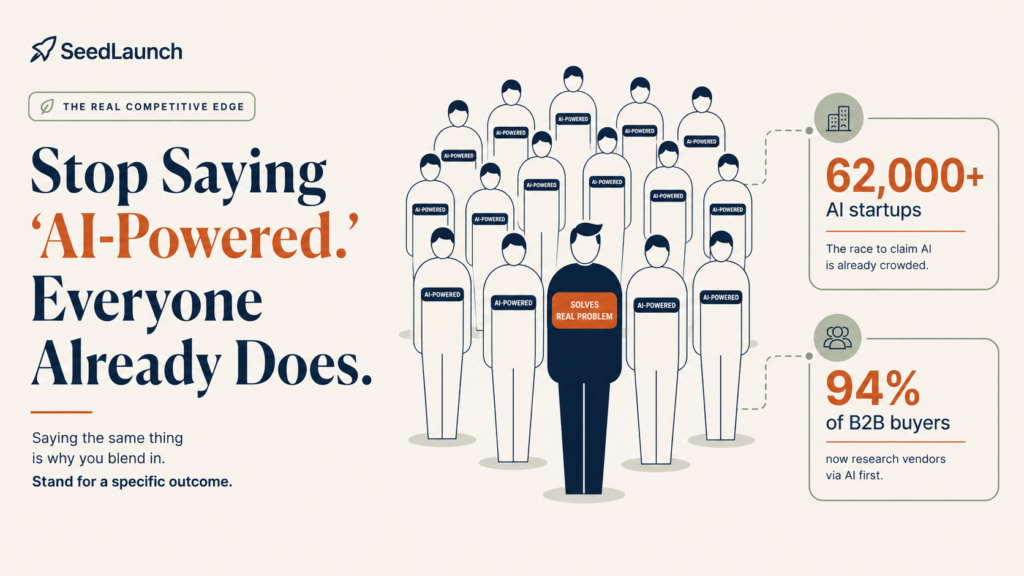
He’s not alone. There are more than 62,000 AI startups operating right now, and a huge share of them are running the exact same three words across their hero section. “AI-powered” used to signal something. Now it signals that you didn’t finish your positioning work.
The Label Stopped Doing Any Work
Here’s the math that should worry you more than it currently does: when a buyer hears “AI-powered,” they don’t file you under a category — they file you under a crowd. You’re not differentiating from your five real competitors anymore. You’re competing with all 62,000 companies for the same generic identity. That’s not a marketing problem. That’s an extinction-level positioning problem, and most founders don’t notice it’s happening because their homepage still gets traffic and their demo calendar still fills up. For now.
The deeper issue is that buyers were never shopping for AI. When someone says “we’re looking for an AI solution,” what they mean is “we have a problem, and we’ve heard AI might fix it.” AI is the mechanism they expect walking in the door. It was never the reason they’d choose you over the next vendor. If your entire pitch is the mechanism, you’ve answered a question nobody actually asked.
Buyers Aren’t Even Reading Your Homepage Anymore
This is the part that should raise the stakes for you specifically, right now, in 2026. Recent research on B2B buying behavior puts AI-assisted vendor research at 94% — buyers are running comparisons, building business cases, and shortlisting vendors inside ChatGPT or Perplexity before your sales team, or your website, ever enters the picture. That shortlist gets assembled from how clearly the internet — reviews, comparison content, case studies — describes what you actually do. A vague “AI-powered platform” claim gives that system nothing to work with. Specificity is what gets pulled into the answer. Vagueness gets summarized as “another AI vendor” and quietly dropped.
So the cost of a fuzzy positioning line isn’t just a weaker headline anymore. It’s invisibility in the exact place most of your buyers are now making the call.
What Replaces It
The fix isn’t clever copywriting. It’s specificity you’re currently avoiding because vague feels safer. “We help mid-market ops leads cut invoice processing from six days to six hours” beats “AI-powered finance automation” every time, because the first sentence tells a buyer exactly what changes for them. If you genuinely use AI — and if you’re reading this, you probably do — say what it does, what data it touches, what output it produces, and where a human still has to sign off. That last part matters more than founders think; naming the limits of the AI is often what makes the claim believable in the first place.
Why This Matters Now, Not Eventually
This isn’t a five-year trend to get ahead of. It’s already reshaping who gets found, who gets shortlisted, and who gets ignored. The startups treating “AI-powered” as their whole personality are going to look, in eighteen months, like the startups that put “cloud-based” on their homepage in 2015 — technically true, and completely useless as a reason to buy.
You don’t need a rebrand. You need one sentence that says what actually changes for the person paying you, and the discipline to lead with it everywhere — your homepage, your outreach, your investor deck. That sentence is the hardest thing to write and the easiest thing to skip, which is exactly why so few founders have done it. We spend a lot of our time at SeedLaunch helping founders find that sentence.