
Most founders chase PMF with more features and more outreach. Here’s the honest, narrower path that actually gets you there.
A founder I worked with last year had eleven “beta customers,” a deck slide that said “strong early traction,” and a churn rate nobody wanted to say out loud. Nine of the eleven had stopped logging in. When I asked her how she knew she had product-market fit, she said, “People keep saying they love it.” That’s not fit. That’s politeness.
Product-market fit isn’t a feeling, and it isn’t a slide. It’s a specific, measurable moment: a defined group of people using your product regularly, paying for it, and getting upset if you took it away. If you can’t point to that group by name, you don’t have it yet — no matter how many demo calls went well.
Stop Building For “Everyone Who Might Like This”
The single most common mistake I see at seed stage is founders trying to find PMF with a product built for a market too wide to feel anything specific. If your ICP is “small businesses” or “teams that collaborate,” you’ve picked a category, not a customer. Categories don’t churn or renew — people do, and specific people have specific pain that shows up in specific words.
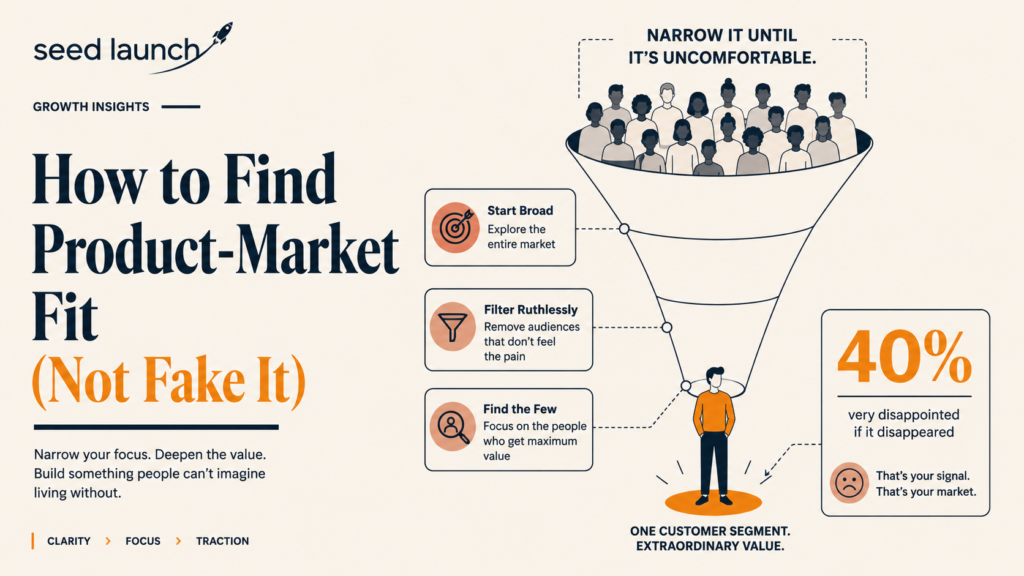
Narrow it until it’s uncomfortable. Not “HR teams,” but “the solo HR generalist at a 40-to-80-person company who’s personally responsible for onboarding paperwork and gets blamed when it’s late.” That person has a Tuesday you can picture. That person has language you can borrow directly for your homepage. Fit gets found in that specificity, not in addressable market size — you can expand the aperture later, after you know what “fit” even looks like for one real group.
Watch Behavior, Not Feedback
Feedback lies. Not maliciously — people are just conflict-avoidant, and “this is great” costs them nothing to say. Behavior doesn’t lie. Track three things instead of asking for opinions: do people come back without a reminder, do they use the product roughly the way you designed it (or have they invented their own use, which is its own signal), and what happens to usage the week after you stop actively onboarding them.
One SaaS founder I advised was convinced her retention problem was a feature gap. The data said otherwise — users who completed one specific setup step in week one retained at 4x the rate of everyone else. The fix wasn’t a new feature. It was forcing that step earlier in onboarding. PMF work is usually diagnostic work before it’s product work.
The 40% Test, and Why Most Founders Are Afraid to Run It
Sean Ellis’s PMF survey — “how would you feel if you could no longer use this product?” — gets cited constantly and run rarely, because founders are scared of the answer. If fewer than 40% say “very disappointed,” you don’t have fit yet, and that number will sting the first time you see it.
Run it anyway. And when the number comes back low, don’t spread the fix across your whole user base. Look only at the segment that did answer “very disappointed” — that’s your real market, hiding inside your broader one. Rebuild your ICP around them, not around the average.
Why This Is Harder Right Now
Buyers in 2026 have sat through years of AI-feature launches that promised transformation and delivered a chatbot bolted onto a sidebar. They’re skeptical by default, and skepticism raises the bar for what “fit” requires — a vague sense of interest used to be enough to justify a pilot; now it isn’t. Capital is tighter too, which means you likely don’t get eighteen months to iterate your way there. The founders finding fit fastest right now are the ones who accepted a smaller, sharper market on purpose instead of discovering it by accident six months in.
Get Honest Before You Get Bigger
You don’t need more traffic, more outbound, or a longer feature list to find product-market fit. You need a narrower, honestly-described group of people and the willingness to look at what they actually do instead of what they politely say. That’s uncomfortable work. It’s also the only version of this that scales.
If you want to run the 40% test properly — the actual survey language, the segmentation cut, how to read the results without lying to yourself — grab the PMF Survey & Segmentation frahttps://seedlaunch.co/productmarketfit/mework, the same one that found that founder her real eleven.