
Most seed rounds cost founders 10% to 25% of the company. Learn how to work out your own number from milestones, runway, and a SAFE model.
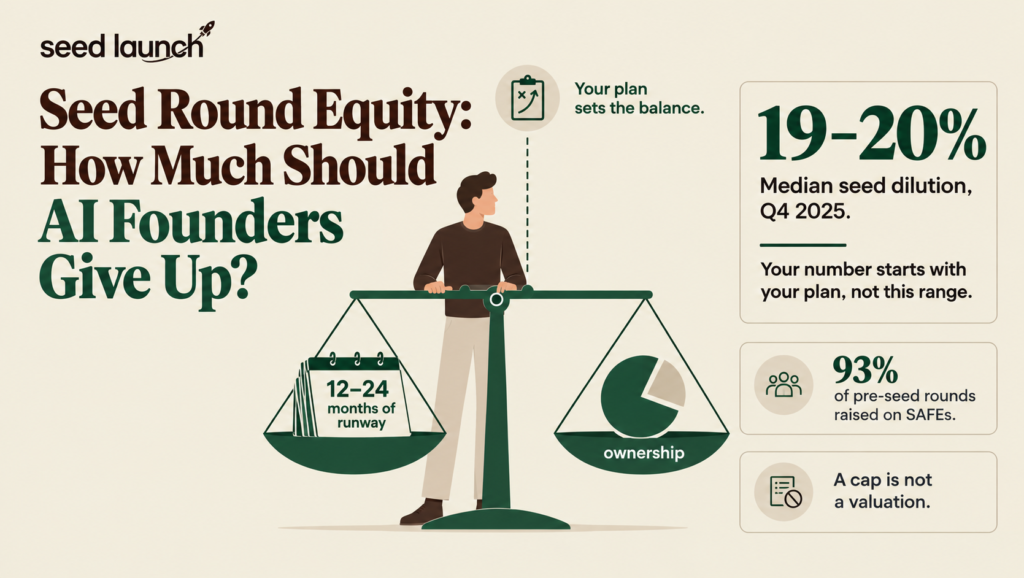
Ask five founders how much equity to give away in a seed round and you’ll hear five answers.
One contributor in a Startups.com community article says never go past 33%. Another says a VC firm will want 10% to 20% of a $1 million round, while angel groups will want 15% to 25%. Meanwhile, Carta’s data puts median seed dilution at roughly 18% to 20%.
Those numbers agree more than they disagree. They still can’t tell you what to do. That’s the problem with most advice on seed round equity for AI founders: the ranges are useful, but they can’t hand you your number.
The Ranges Are Guardrails, Not Answers
Treat every percentage you read as a guardrail. The community figures come from individual founders and investors describing their own deals. The Carta figure is a median, which means half of all deals were bigger.
The same article offers a Series A rule of thumb: cap founder dilution around 30% and expect a 10% option pool before the investor arrives. That leaves the founding team with roughly 60%. It’s a sensible target. But the contributor framed it for businesses that don’t need huge amounts of capital, and your company might not be one of them.
Seed Round Equity for AI Founders Starts With a Plan, Not a Percentage
Equity is the price of your plan. Write the plan first, and the percentage becomes an output instead of a guess.
Start with milestones. List what makes you fundable at the next round: a shipped product, paying users, proof of product-market fit, a key hire. Next, estimate what each one costs and how long it takes. Aim for 12 to 24 months of runway, and add a buffer, because fundraising itself can take months. That total is your target raise.
Then run the dilution. Divide the raise by the post-money valuation you can defend, and see what slice it costs. For example, $2 million on a $10 million post-money valuation costs you 20%. If the answer scares you, shrink the plan or stretch the runway. Don’t just negotiate a bigger number and hope.
Read Your SAFE Before You Trust Your Cap
Most early rounds run on SAFEs. Carta data shows about nine in ten pre-seed rounds in late 2025 used one, because a SAFE lets you raise fast without fixing a valuation.
It also hides a trap. A valuation cap is not your company’s valuation. It’s a contract term that only matters when something converts the SAFE, like a future priced round or an exit. Founders see a $10 million cap and think they’ve sold at $10 million. They haven’t.
Stacking is the second trap. Raise on three SAFEs with three different caps and discounts, and your cap table gets messy fast. It’s one of the most common first-fundraise mistakes. So model every SAFE in a calculator before you sign, and you’ll know how much of the company you’ll own after the next round.
Why AI Founders Feel This Harder
AI companies face real costs early: compute, specialist hires, data. That pushes founders toward bigger rounds, and the money is following. Roughly half of pre-seed dollars in the first half of 2026 went to AI companies, and the average pre-seed check hit a record $276,000 in Q2 2026.
Still, both ends of the problem hurt. Raise too little and you’re fundraising again before you have results. Raise too much and you may give away more ownership than your stage warrants. The Startups.com contributor made the case for taking the hit, arguing that owning 70% of something big beats owning all of something small. That’s true. It’s also easy to overdo when you’re desperate for cash, and selling too much too early leaves you with little to own.
With checks getting bigger, every point of equity you give away needs a reason.
Do This Before Your Next Investor Call
Write your milestone list tonight. Put a cost and a date next to each item. Then run the dilution and see what it really costs you. Before you open the round, run the four readiness checks in Pre-Seed Funding for AI Startups: Are You Ready?
If you can’t write that list because you don’t yet know whether your product fits a market, SeedLaunch’s Seed plan is where to start, and the Scale plan is for founders who already have product-market fit.