
Low signup-to-result conversion? Learn how to increase product activation rate with five fixes AI and SaaS founders can ship this week.
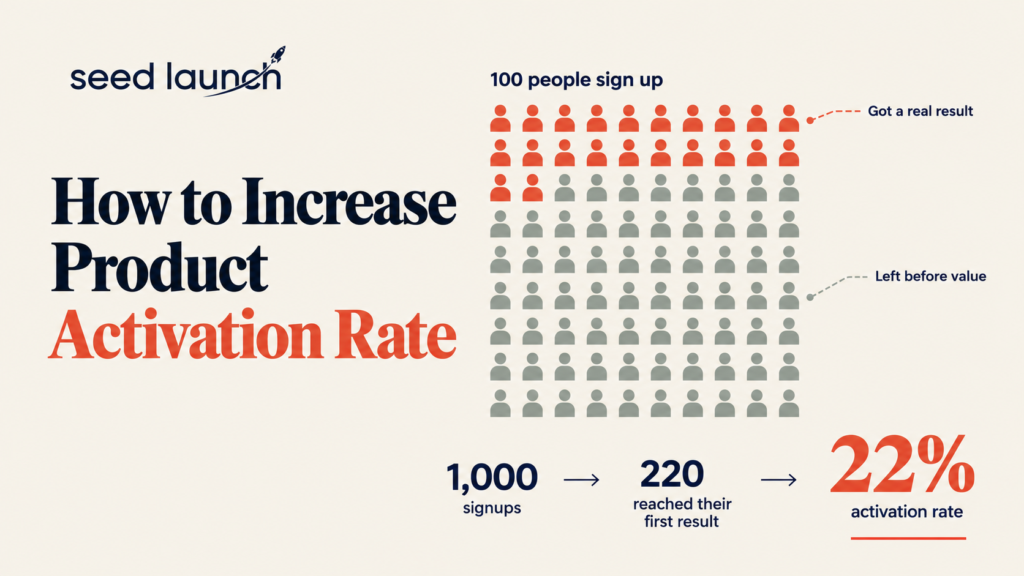
Open your analytics dashboard and find two numbers. The first is how many people signed up last month. The second is how many of them got a real result from your product. The gap between those two numbers is your product activation rate, and for most AI founders it’s lower than expected.
Product activation rate is the share of new signups who reach your activation event within a set window, usually seven days. Say 1,000 people sign up and 220 reach it. Your activation rate is 22%. Every channel you run feeds into that number, so it’s the first one worth fixing.
Start With One Clear Activation Event
Most teams skip this step, then wonder why the number won’t move. Your activation event is the first action that proves a user got value. A signup doesn’t count. A finished profile doesn’t count. A login doesn’t count.
For an AI contract-review tool, the event is the first contract a user uploads and gets flagged clauses back on. For an AI meeting assistant, it’s the first summary a user shares with a teammate. Pick the action that signals value, not the one that signals effort.
To find yours, compare two groups: users still active after 30 days, and users who vanished in week one. Look for the early action the retained group almost always took. That’s your activation event.
Why AI Products Lose People Before the First Win
AI products carry friction that classic SaaS tools don’t. Three problems show up again and again.
The first is the blank box. A new user lands on an empty prompt field and has no idea what to ask. Smart people freeze here.
The second is the trust gap. Users hesitate to upload real contracts, customer lists, or code before they believe the output will be good.
The third is the setup wall. Integrations, API keys, and permissions all sit between the user and the first result. Each extra step costs you people, and the ones who leave never tell you why.
Picture those problems in the contract tool. Of 1,000 signups, 350 never upload a document because they don’t trust you with a real one. Another 200 start the integration and quit halfway. Only 220 reach the flagged clauses. That’s not one traffic problem. It’s three onboarding problems, and each one has a fix.
Five Ways to Raise Product Activation Rate
Cut the path to first value. Count the clicks between signup and the first useful result. Remove every click that isn’t required. Move inviting teammates, billing, and profile setup until after activation.
Give people something to start with. Ship sample documents, template prompts, or a demo workspace. A user who sees a good output on sample data will trust you with their own.
Ask one question, then personalize. “What are you here to do?” with three choices lets you drop each person into the right first task. One question beats a generic product tour.
Follow behavior, not a calendar. Trigger emails when someone stalls, not on day two and day five for everyone. “You uploaded a file but didn’t run the review” beats “Here are five tips” every time.
Talk to your first 50 users. Email each new signup or book 15 minutes with them. You’ll learn the real blocker within a week, and no dashboard will show it to you.
Here’s the plain version of all this: low activation is rarely a feature problem. It’s a clarity problem. Users don’t know what your product is for, what to do first, or why it’s safe to try. If your homepage promise is vague, AI startup positioning is where the fix starts, before you touch onboarding.
Why Activation Matters More Right Now
Capital is tighter, and investors ask about retention earlier than they used to. AI products are also easy to try and easy to drop, because another tool is always one browser tab away. If you pay for traffic that lands in a leaky onboarding flow, you burn cash twice. More leads won’t fix a growth problem that starts after the signup.
Activation is also your earliest product-market fit signal. If new users can’t reach value in week one, retention won’t rescue you in month three. When you want to test that bigger question, start with how to know product market fit.
Pick Your Number This Week
Choose your activation event. Measure the gap between signups and activated users. Then fix the biggest drop-off first, not the most interesting one. You’ll move this number faster than you expect, because most of the loss sits in two or three steps.
If you can’t tell whether your drop-off comes from onboarding, positioning, or product-market fit, that’s exactly what the SeedLaunch Seed plan is built to find out.