
A founder we spoke with recently turned off an $18K/month ad campaign in month nine of running it.
Leads dropped to zero within four days.
Not “slowed down.” Zero. The pipeline that had looked, on paper, like a growth engine turned out to be a faucet — open while the money was flowing, dry the second it stopped. Nine months and roughly $160K in, the company had nothing left over that worked without the spend attached to it.
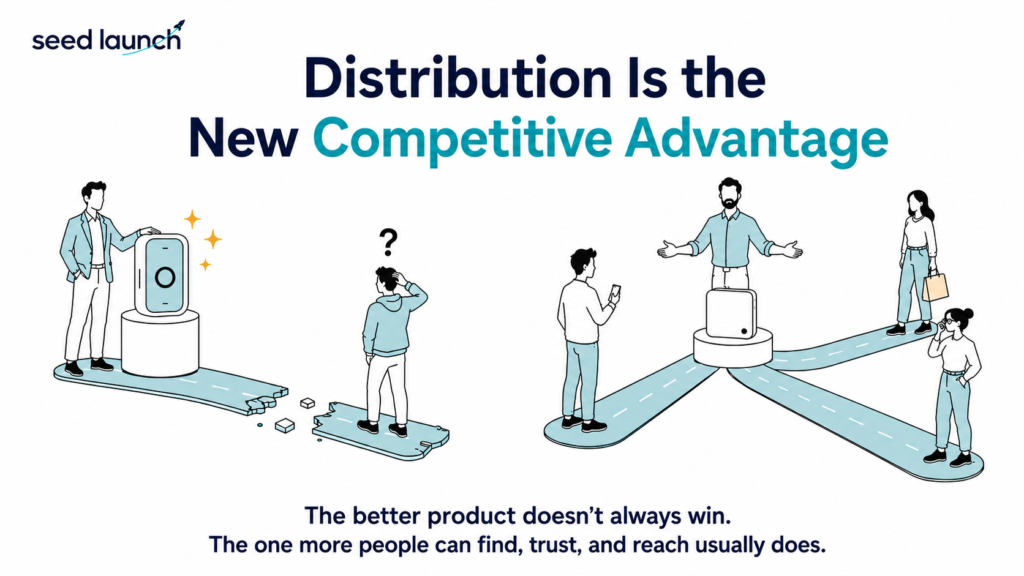
That’s not a story about wasting money on ads. Ads did exactly what they were bought to do. It’s a story about mistaking a rented channel for an owned one — and that distinction is the part of “distribution as competitive advantage” that most founders skip past.
Two Very Different Kinds of Distribution
Almost every acquisition channel available to a seed-stage company falls into one of two categories.
Rented distribution : you pay for continuously, and it disappears the moment you stop: paid ads, cold outbound lists, influencer placements, most SEO built on volume rather than authority. The price of a rented channel also isn’t fixed — it moves with how many other companies are bidding for the same attention, which at seed stage is usually a losing trend, not a stable one.
Owned distribution: you build once and it keeps working without ongoing spend: a customer base that refers people unprompted, a founder whose name people search directly, a community that answers its own questions, a body of content specific enough that people find it by searching the exact problem it solves. Owned distribution has a cost too — but it’s mostly time, not a recurring invoice.
Both are legitimate. The problem isn’t that founders use rented distribution. It’s that most seed-stage marketing budgets are almost entirely rented, because rented channels are easy to measure and easy to defend in a board update — “we spent $X, we got Y leads” is a clean sentence. Owned distribution takes longer to show up in a dashboard, so it gets deprioritized precisely when it would be cheapest to start building.
That’s the asymmetry worth naming: the earlier you are, the more owned distribution costs you in time and the less it costs you in cash — which is exactly the trade a cash-poor, time-flexible seed-stage company should be making, and exactly the trade most of them don’t.
The Light-Switch Test
Here’s a fast way to audit where you actually stand. Imagine turning off every dollar of paid spend for 30 days. What’s still generating pipeline?
If the honest answer is “nothing,” you don’t have a distribution advantage yet — you have a distribution expense. That’s not a failure. Almost every company starts here. But it means the acquisition number on your dashboard is telling you less than it looks like it’s telling you. It’s measuring rented reach, not compounding advantage.
Run the same test on a competitor you’re worried about. If their organic traffic, referral rate, and inbound demo requests would survive their ad budget going to zero and yours wouldn’t, that’s the actual gap — not your feature set, not your pricing.
What Owning Distribution Actually Looks Like at Seed Stage
This isn’t a call to abandon paid channels — rented distribution is often the fastest way to get your first real signal on messaging and ICP, and speed matters when you’re pre-PMF. It’s a call to spend a deliberate portion of that early motion building something that outlasts the invoice:
Documented proof, not just testimonials. A specific, named result from a specific customer, written up in enough detail that a prospect trusts it more than your ad copy. This gets reused for years; an ad impression doesn’t.
A founder who answers in public. Not a content calendar — actual answers to actual questions your buyers are asking, in the places they already look. This is slow to compound and, once it does, nearly impossible for a competitor to buy their way into.
A referral loop that’s a real mechanism, not a hope. Something specific happens after a customer gets value — an intro request, a shareable result, a reason to mention you — rather than assuming happy customers will think to bring it up unprompted.
None of these show up in next month’s CAC. All three are still working in month eighteen without another dollar spent.
The Actual Question to Ask
Not “which channel should we try next” — but “which of our current channels would still exist if we stopped paying for it tomorrow.”
If the honest answer is none of them, that’s not a crisis. It’s just a sign that the distribution advantage everyone talks about hasn’t been built yet — only rented, one month at a time.