
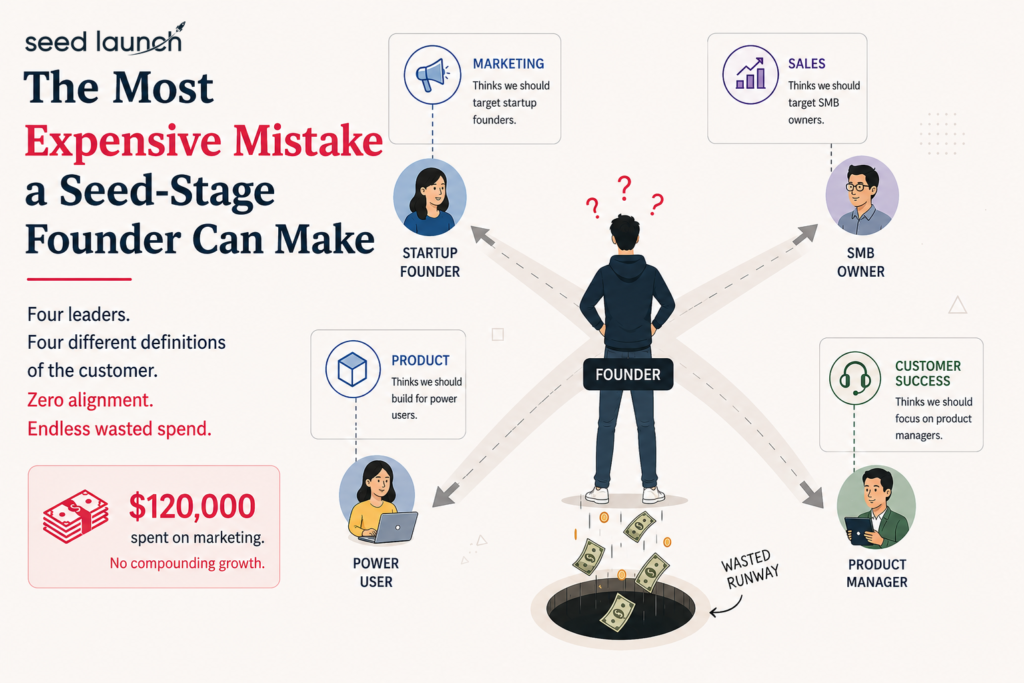
A founder we were speaking with recently told us something that stopped us mid-sentence.
“We’ve spent over $120,000 on marketing this past year.”
That’s a real number. That’s runway. That’s a hire, or two, or three. That’s six more months of building. So naturally, we leaned in and asked what we thought was a simple follow-up.
“Who’s your ideal customer?”
The room went quiet.
Not the kind of quiet that comes before a confident answer. The kind of quiet that comes when everyone is doing mental math, trying to figure out if their answer will match the person sitting next to them.
It didn’t.
Four people. Four different answers.

The CEO had one definition. Sales had another. Marketing had a third. Customer Success — the team closest to the people actually using the product — had a fourth.
Four leaders. One company. Zero agreement on who they were actually building for.
That’s when it hit us: this wasn’t a marketing problem. It was never a marketing problem. It was a customer alignment problem wearing a marketing costume. And alignment problems are, without question, the most expensive mistakes a seed-stage founder can make — because they don’t show up on a single line item. They hide inside every line item.
The Real Cost of Customer Misalignment
Here’s the thing about spending $120,000 without a shared definition of your customer: you’re not making one bad decision.
You’re making hundreds of small, well-intentioned, completely disconnected decisions — and paying full price for each one.
Look at how it plays out in practice:
Every ad campaign was optimized for a slightly different persona. Every landing page spoke to a slightly different pain point. Every sales call opened with a slightly different pitch. Every product roadmap decision was shaped by whichever version of “the customer” happened to be loudest in the room that week.
Individually, none of these decisions looked wrong. Each team was doing good work by their own definition.
The ads were well-designed. The landing pages converted okay. The salespeople were skilled. The product team shipped fast.
But none of it compounded — because none of it was pulling in the same direction.
That’s the part founders miss. Misalignment doesn’t feel like failure in the moment. It feels like activity. It feels like progress. Dashboards are full, calendars are full, spend is flowing.
But when you zoom out six or twelve months later, you find a company that spent six figures building four different businesses at once — and calling it one.
Why This Happens (Even to Smart Teams)
We want to be clear about something: this isn’t a story about a founder who didn’t know what they were doing. This was a sharp, capable team. Good instincts. Strong execution skills.
That’s exactly why this pattern is so dangerous — it doesn’t only happen to inexperienced founders. It happens to experienced ones who are moving fast and assume alignment because everyone is smart and everyone is busy.
Here’s how it usually creeps in:
In the earliest days, the founder holds the entire customer definition in their head. They talk to every user. They write every piece of copy. They’re on every sales call.
Alignment isn’t a “strategy” — it’s just proximity. One person, one brain, one understanding of who this is for.
Then the company grows. A marketing hire joins and builds their own mental model from the data they see. A salesperson joins and forms their own model from the deals they close. A CS hire joins and forms their own model from the support tickets they handle.
Each of these models is reasonable. Each is built from real signal. But none of them were ever explicitly written down, debated, and agreed upon as the company’s official definition of the customer.
So the company doesn’t drift because people are careless. It drifts because nobody ever paused to make the implicit explicit.
Why This Matters More in Today’s Funding Environment
A few years ago, a founder could get away with this. Capital was cheap, growth was rewarded almost regardless of efficiency, and “we’re testing a few segments” sounded like a strength, not a warning sign.
That environment doesn’t exist anymore.
Investors today are asking sharper, more uncomfortable questions. Not just “how fast are you growing,” but how efficiently are you growing. Not just “do you have a go-to-market motion,” but is it repeatable. Not just “what’s your CAC,” but can you explain, in one sentence, exactly who that CAC is buying you — and can everyone on your team give you the same sentence?
A repeatable growth engine cannot be built on top of a company that can’t describe its own customer consistently. Repeatability requires a fixed target.
You can’t systemize a motion that’s aiming at four different destinations depending on which department is doing the aiming. Every “optimization” becomes noise instead of compounding signal, because you’re optimizing four separate, half-built funnels instead of sharpening one.
This is why capital efficiency and customer clarity are really the same conversation. Inefficient spend is rarely a pricing problem or a channel problem at its root. Far more often, it’s a definition problem that shows up disguised as a budget problem.
What Real Customer Alignment Looks Like
To be fair, “know your customer” is advice every founder has heard a thousand times. It’s practically wallpaper at this point. So let’s be specific about what actual alignment looks like, because it’s more rigorous than most teams assume.
It’s not enough for your team to agree on a broad industry or company size. Real alignment means your CEO, your Head of Sales, your Head of Marketing, and your Head of Customer Success could each be pulled into separate rooms, asked “who is our ideal customer,” and come back with answers that overlap almost word for word.
Not just in demographics, but in the specific problem this person has, the moment in their life or business when that problem becomes urgent, and what they’ve already tried that hasn’t worked.
That level of specificity is what turns “ideal customer” from a slide in a pitch deck into an operating principle. When it’s that specific, marketing knows exactly what pain to lead with. Sales knows exactly what objection to expect.
Product knows exactly which feature request matters and which one is noise. Customer Success knows exactly what “success” is supposed to look like for this person.
That’s when spend stops being a bet and starts being a system.
How to Fix It
The good news is that solving this doesn’t require a rebrand, a new positioning consultant, or another six figures of spend. It requires something much simpler and much harder: getting your leadership team in a room and refusing to leave until everyone can say the same sentence about who you serve.
That conversation will surface disagreement. It should. Better to have that disagreement in a conference room for an afternoon than to have it quietly play out across a year of ad spend, sales calls, and roadmap decisions.
Write the definition down. Not a vague persona slide nobody references again, but a working document everyone on the team can point to and say, “yes, that’s who we’re building for, and that’s the exact problem we’re solving for them.”
Then use it as the filter for every major decision — every campaign, every landing page, every sales script, every roadmap debate. If a decision doesn’t map cleanly back to that shared definition, that’s a signal worth pausing on before the check clears.
Get Aligned Before You Scale
Every founder wants to scale marketing. Scaling feels like progress — more spend, more leads, more activity, more motion. It’s genuinely satisfying to watch the numbers climb.
But scaling a misaligned engine doesn’t fix the misalignment. It just makes it more expensive, faster.
Before you put another dollar into growth, sit down with your leadership team and ask the same question we asked that founder. Don’t move on until every answer in the room matches.
The most expensive mistake a seed-stage founder can make isn’t a bad campaign or a slow quarter — it’s a team that’s moving fast in four different directions and mistaking the motion for progress. If your leadership team can’t say the same sentence about your customer, that’s the conversation to have before the next dollar goes out the door.